
How One! International School Ran a Pilot Before Rolling Out a Platform to 1,000+ Users

Rolling out a new digital platform in a large school always carries risk. When over 1,000 people are involved, an unprepared launch can create serious challenges for administrators, teachers, and parents alike. That’s exactly why One! International School chose not to rush. The school conducted a pilot phase before scaling the platform.
We spoke with Mr. Alex, the project lead on the school’s side, to understand how the pilot was organized, what was tested, and what insights shaped the final rollout.
Why the School Started Looking for a New Platform
At the start of the project, the school was already using an electronic gradebook. However, the existing system did not allow administrators to work with data in the way they needed.
The main issue was fragmentation. Data had to be collected fr om multiple sources. Some had to be exported, while others were manually added. This work was done not by analysts, but by regular staff members. As a result, the data was often inconsistent, unstructured, and time-consuming to process.
For the school, this became a critical issue. If management decisions are delayed by even 1–2 months, the consequences can be significant. Ideally, decision-makers need visibility into data on at least a weekly basis.
The gap was obvious: the school needed one unified tool to bring all its data into one place, offer a clear view of performance, and simplify reporting.
Why They Chose to Start with a Pilot
Even though the new platform seemed like a strong fit, the team didn’t take the risk of launching it school-wide right away. In large IT projects, a pilot phase is not optional—it’s essential.
As Mr. Alex explains:
“I’ve worked on more than ten system implementation projects. Without a pilot, it’s nearly impossible. You need to see how the system works in real conditions—how data is created, wh ere it appears, and which processes can be automated.”
The pilot helped the school:
- assess usability for teachers, students, and parents;
- understand what data the platform could provide;
- test academic reporting;
- prepare a structured plan for full implementation.
It also helped build an internal team of early adopters who could later support their colleagues during the transition.
Preparing for the Pilot
One of the most time-consuming stages was data preparation. Even if a platform supports automated uploads, data still needs to be collected, cleaned, and structured beforehand.
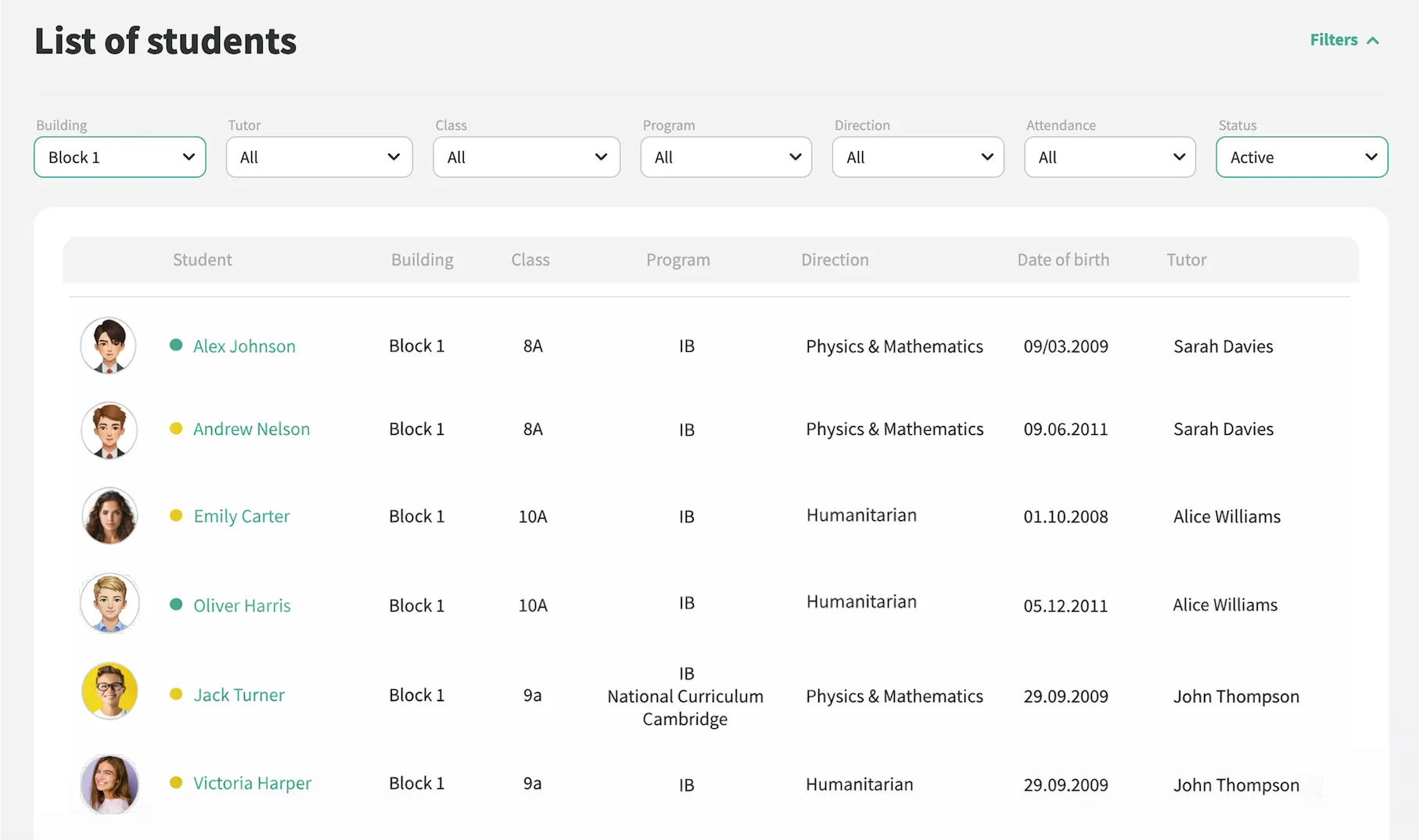
The system was opened in mid-February, but testing did not begin immediately. First, the team had to prepare a large amount of data, including user lists, class structures, and schedules. Only after uploading and configuring this data could full testing begin.
How the Pilot Was Organized
The pilot ran for about two months and involved:
- 3 school classes;
- 3 kindergarten groups;
- around 30 staff members.
The selection of participants was deliberate.
Fifth-grade teachers were chosen because they were among the most experienced users, allowing for faster adoption and peer support.
Senior classes helped test more complex scheduling structures, such as split groups and advanced schedules.
Kindergarten groups were included to evaluate how well the platform supports communication with parents.
Team Roles and Responsibilities
The pilot was conducted by a small internal team. Mr. Alex acted as project lead, coordinating the process. The team also included methodologists, deputy principals, and homeroom teachers.
“Methodologists were primarily responsible for operational setup—creating schedules, verifying class structures, and testing different workflows. Some team members also tested the system from a parent’s perspective to understand the user experience.”
What Was Tested During the Pilot
The school focused on several key areas.
First, usability. The platform needed to be intuitive for teachers, students, and parents. The interface shouldn’t be too different from what they’re used to. Some changes are fine, but ideally within a 25–30% range so the transition stays smooth.
Second, data and analytics. The team evaluated what data could be extracted and whether it could support management decisions.
Special attention was given to academic reports. Previously, reports were created manually: data was entered into spreadsheets, and teachers compiled individual PDF reports. The pilot allowed the team to compare time spent and assess how much the new system could streamline this process.
The Biggest Challenge: User Resistance
The biggest challenge of the pilot wasn’t technical—it was human.
“People generally don’t like control systems. Any new system creates resistance. That’s why it’s important to explain the purpose behind it.”
For teachers, the platform meant changing established workflows. So success depended not only on the system itself, but also on how it was introduced and explained.
The key was showing real value. Once people saw that the platform actually reduced manual work and did not add more, they started to accept it. Over time, as they experienced the benefits firsthand, the resistance naturally decreased.
When It Became Clear the System Was Ready to Scale
By the end of the pilot, the team was confident the platform could be rolled out across the entire school.
The system provided a comprehensive view of subjects, teachers, and assessments, and enabled regular access to up-to-date data for faster decision-making. Additionally, report preparation became significantly faster, and reliance on manual data collection was reduced.

User feedback reinforced this conclusion. One teacher, after seeing how an academic report was generated, asked:
“That’s it? It’s really that simple?”
This reaction highlighted how much the system simplified everyday tasks and reduced routine workload.
The School’s Key Takeaway
System implementation is not a one-time action—it’s a process that requires preparation.
The pilot demonstrated that launching without a testing phase in a large school almost inevitably leads to problems. There are simply too many processes, users, and data points to “switch everything on” and expect stability from day one.
A pilot allows teams to navigate this complexity in advance: to understand how the system works in practice, identify challenges, and establish clear workflows.
As Mr. Alex puts it:
“If you’re implementing a system across the entire school, you have to be ready for some chaos at the beginning. The key is making that chaos manageable.”
This approach turns inevitable implementation challenges into a structured, controlled process—with clear roles, steps, and expected outcomes.